
New Delhi, June 9: The Reserve Bank of India (RBI) has issued a compounding order under Section 15 of the Foreign Exchange Management Act (FEMA), 1999, in the case of Universal Biofuels Private Limited, bringing FEMA proceedings against the company to a close.
According to an official release, the compounding order was issued after the Enforcement Directorate (ED) granted a “No Objection” to the proposal, paving the way for the RBI to settle the matter through the compounding mechanism provided under FEMA.
The case originated after the ED initiated an investigation under FEMA based on credible information regarding an alleged violation of foreign exchange regulations. Following the investigation, the ED filed a complaint under Section 16 of FEMA before the Adjudicating Authority.
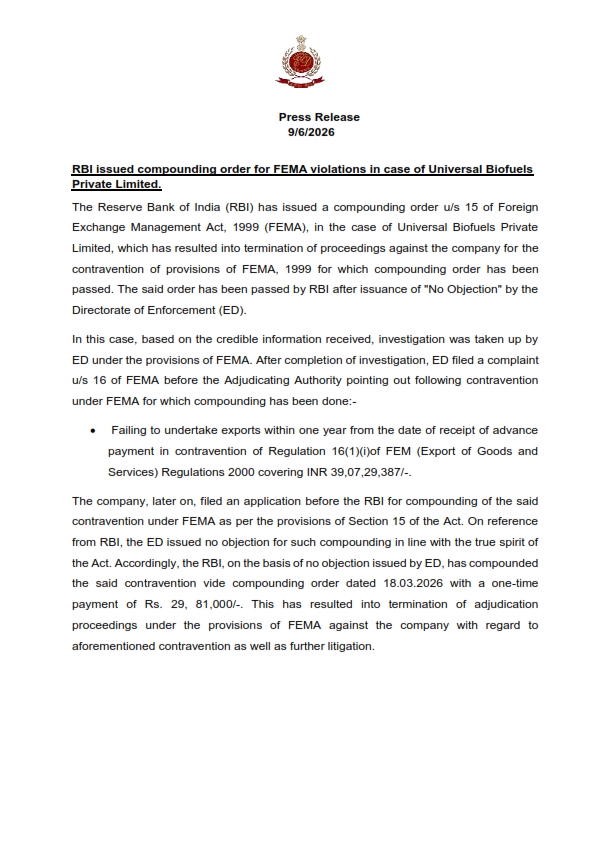
The investigation found that the company had allegedly failed to undertake exports within one year from the date of receiving advance payment, constituting a violation of Regulation 16(1)(i) of the Foreign Exchange Management (Export of Goods and Services) Regulations, 2000. The alleged contravention involved a transaction amounting to approximately ₹39.07 crore.
Subsequently, Universal Biofuels Private Limited approached the RBI seeking compounding of the violation under the provisions of Section 15 of FEMA. The RBI, in turn, sought the views of the Enforcement Directorate before taking a final decision.
After examining the matter, the ED conveyed its no-objection to the RBI, stating that compounding of the contravention would be in line with the provisions and spirit of the Act.
Based on the no-objection received from the Enforcement Directorate, the RBI passed a compounding order dated March 18, 2026, allowing the violation to be settled upon payment of a one-time compounding amount of ₹29.81 lakh.
Officials said the compounding order has resulted in the termination of adjudication proceedings under FEMA against Universal Biofuels Private Limited in relation to the specified violation. The order also brings an end to any further litigation connected with the contravention covered under the compounding process.
The case highlights the mechanism available under FEMA through which certain regulatory violations can be settled upon payment of a prescribed amount, subject to approval by the competent authorities and compliance with applicable legal provisions.