New Delhi: The Najafgarh drain, long identified as the single largest source of pollution in the Yamuna river, contributes nearly 70 percent of the total contaminants flowing into the river, according to official data. For years, efforts to clean the Yamuna remained confined to policy documents and political assurances. That narrative, the Delhi government claims, is now changing.
In a significant technological intervention, the government has deployed a high-tech amphibious dredging machine imported from Finland to mechanically clean the Najafgarh drain—marking a shift from symbolic action to on-ground execution.
The machine, known as the Water Master Amphibian Multi-Purpose Dredger, is capable of operating seamlessly on both land and water. It can function at depths of up to six metres, making it suitable for removing accumulated sludge from deep and heavily polluted drains.
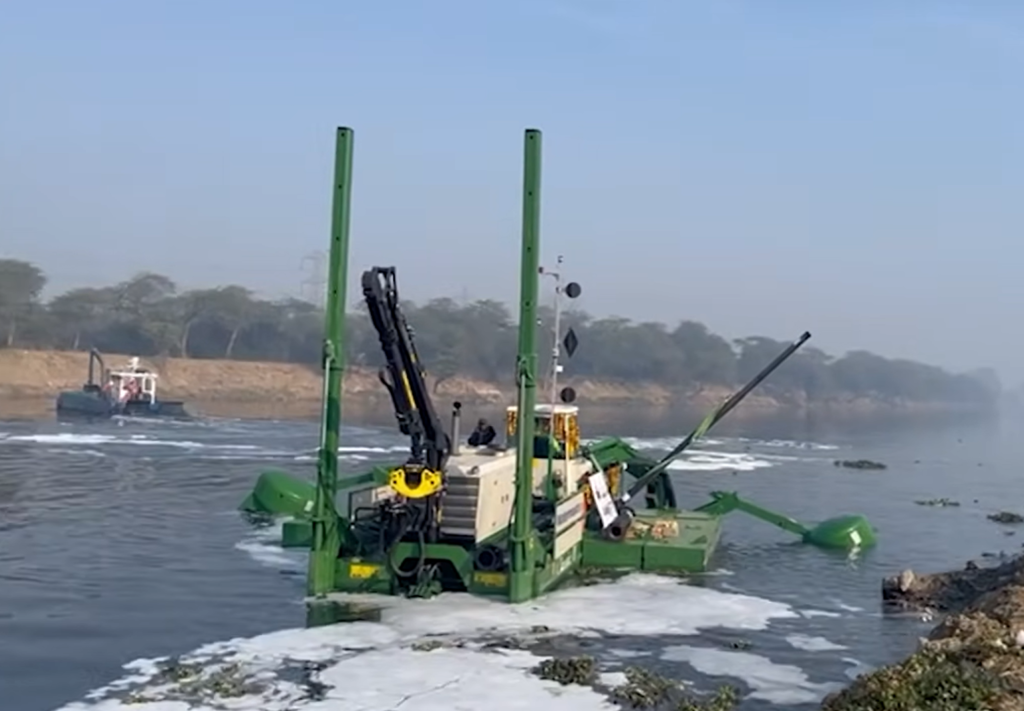
One of its key features is its sludge pumping capacity of 600 cubic metres per hour, allowing it to extract large volumes of silt and waste in a short time. Beyond sludge removal, the machine can cut through solid waste, remove water hyacinth, and dispose of debris up to 1.5 kilometres away. To ensure transparency and monitoring, it is equipped with GPS tracking and fuel sensors.
The machine was recently inaugurated at the Najafgarh drain by Delhi’s Irrigation and Flood Control Minister Parvesh Sahib Singh Verma. The cost of the dredger is approximately ₹8.04 crore, while three hopper barges, used for transporting waste material, have also been deployed at an additional cost of ₹5.25 crore.
According to the government’s roadmap, this initiative will not be limited to Najafgarh alone. Mechanical cleaning of all 32 major drains connected to the Yamuna is planned. If the current trial proves successful, more such machines will be deployed across Delhi.
नजफगढ़ ड्रेन में फिनलैंड से आई अत्याधुनिक ‘वॉटर मास्टर’ मशीन अब कार्यरत है। यह मशीन दशकों पुरानी सिल्ट को आधुनिक सक्शन तकनीक से हटाकर जल प्रवाह को सुचारु बनाएगी और बाढ़ व प्रदूषण नियंत्रण को मजबूती देगी। यमुना और नालों की स्वच्छता की दिशा में यह एक अहम कदम है। pic.twitter.com/DTJzT2P7ut
— Parvesh Sahib Singh (@p_sahibsingh) January 16, 2026
Experts, however, caution that technology alone cannot revive the Yamuna. They stress that stopping pollution at the source remains the most effective solution. If even a significant portion of Najafgarh drain’s discharge is treated before entering the river, meaningful rejuvenation of the Yamuna could be achieved.
Minister Parvesh Sahib Singh Verma has asserted that this clean-up drive will no longer remain a media announcement but will be driven by action, technology, and accountability. The government aims to deploy 32 such machines by March 2026 to clean the entire drainage network feeding into the Yamuna.
The larger question now remains—
Can advanced Finnish technology succeed where decades of promises failed, and restore the Yamuna to its former glory?