
New Delhi: The Election Commission of India has ordered a comparison of electoral rolls before and after Special Intensive Revision (SIR), followed by house-to-house visits to help eligible voters whose names are missing apply for enrolment through Form 6.
The special drive also covers left-out, first-time and young electors. Booth Level Officers (BLOs) are to identify people listed in the pre-SIR roll but absent from the current roll, check their present status and facilitate applications wherever they are eligible.
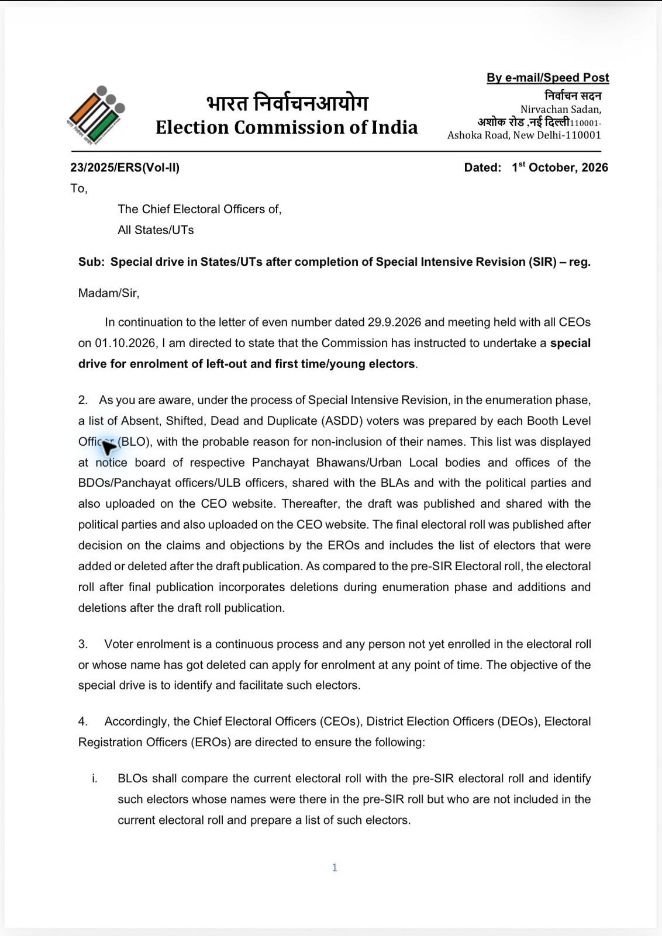
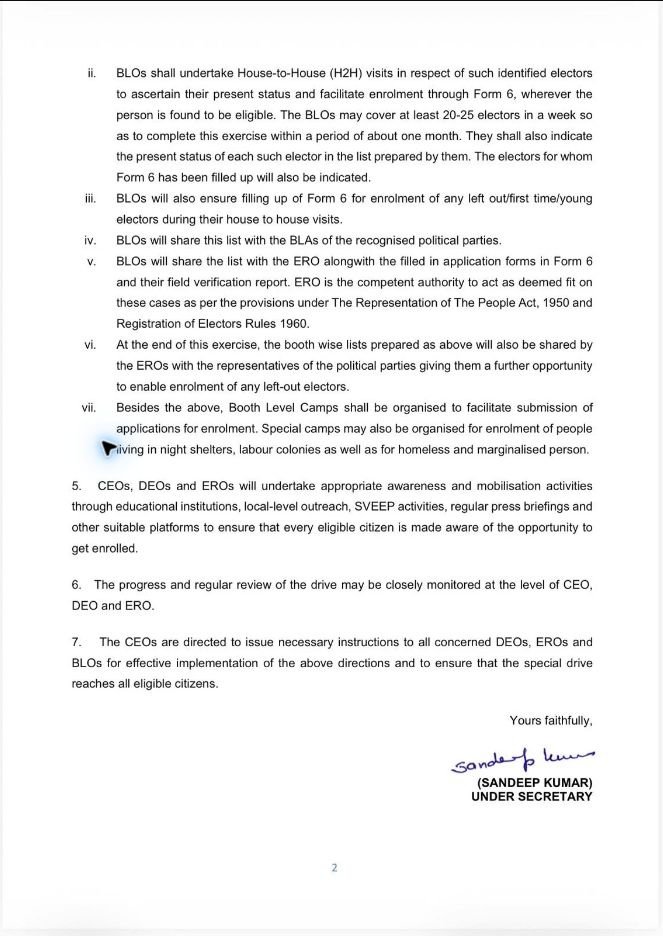
The Commission’s October 1 instructions to Chief Electoral Officers of all States and Union Territories envisage BLOs covering at least 20–25 electors a week to complete the exercise in about a month. This is an operational target for the drive, rather than a fixed nationwide deadline for voters to apply.
View the Election Commission’s original post and special enrolment drive directions
A missing name must be checked; enrolment is not automatic
BLOs must record each identified elector’s present status and indicate which electors have filled Form 6. They will submit the lists, completed applications and field verification reports to the Electoral Registration Officer (ERO), who is the competent authority to act under the Representation of the People Act, 1950 and the Registration of Electors Rules, 1960.
The direction therefore provides a route to identify and assist eligible people; it does not order automatic restoration of every name missing from the current roll. ECI reiterates that voter enrolment is continuous and a person not enrolled, or whose name has been deleted, can apply for enrolment at any time.
Lists to be shared with political parties
BLOs will share their lists with Booth Level Agents (BLAs) of recognised political parties. At the end of the exercise, EROs will also share booth-wise lists with party representatives, giving them a further opportunity to help eligible left-out electors enrol.
The letter explains that SIR’s enumeration phase produced lists of absent, shifted, dead and duplicate (ASDD) voters, with probable reasons for non-inclusion. These were displayed at designated local offices, shared with BLAs and political parties, and uploaded on CEO websites. Draft rolls were subsequently published and shared; final rolls followed ERO decisions on claims and objections.
The final roll therefore reflects deletions during enumeration as well as additions and deletions after draft publication. The special drive seeks to compare that current roll with the pre-SIR roll to identify people needing further verification and assistance.
Booth camps and outreach for marginalised voters
Booth-level camps are to facilitate enrolment applications. Special camps may also be organised for people living in night shelters and labour colonies, and for homeless and marginalised residents.
CEOs, District Election Officers and EROs are to undertake awareness and mobilisation through educational institutions, local outreach, SVEEP activities, regular press briefings and other suitable platforms. They must monitor progress and regularly review the drive, with CEOs issuing implementation instructions to the officials concerned.